

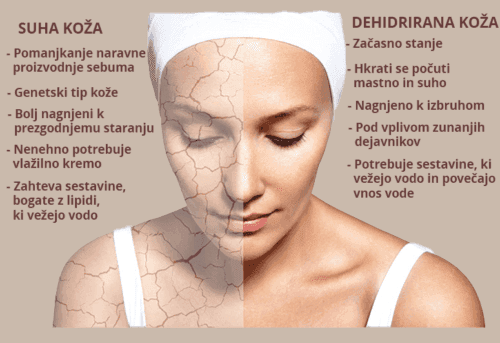





Dry skin refers to a skin type in which the skin produces too little of a natural oil called sebum. This lack of sebum leads to dryness of the skin, which is accompanied by slight flaking, roughness and a feeling of tightness. Dry skin is often caused by genetic factors, ageing, environmental influences or improper skin care.
Dehydrated skin, on the other hand, refers to a skin condition that lacks water. This means that the skin loses moisture and becomes dehydrated. Dehydrated skin can be caused by sun exposure, ageing, the use of inappropriate skin care products or weather conditions.
Sometimes the terms “dry skin” and “dehydrated skin” are used synonymously, but it is important to understand the difference between these two conditions. Dry skin is usually associated with a lack of the skin’s own sebum, while dehydrated skin means a lack of moisture in the skin. So, you can have dry skin, dehydrated skin or both, depending on the factors affecting your skin.
What causes dry skin:
What causes dehydrated skin:
Symptoms of dry skin:
Scaliness: dry skin often indicates the presence of tiny scales.
Roughness: the skin may feel rough and uneven to the touch.
Dryness: a lack of moisture in the skin causes a feeling of dryness.
Appearance of dryness: the skin may look dry as fine lines appear.
Symptoms of dehydrated skin:
Tightness and roughness: dry skin often causes a feeling of tightness and roughness.
Sensitivity: skin becomes sensitive to touch.
Matte appearance: dehydrated skin can look tired and lack radiance.
Fine lines, deep wrinkles and sagging skin: loss of moisture can accentuate fine lines, cause deep wrinkles and sagging skin.
Štukljeva cesta 46
1000 Ljubljana
Slovenia
info@crystalmc.si
01 235 50 20
© 2024 – Crystal Medical Center – Privacy Policy – General Terms and Conditions
“I have suffered from chronic joint pain, especially in my knees, for several years. Traditional treatments such as physical therapy, painkillers and even corticosteroid injections have only provided temporary relief. Desperate for a more permanent solution, I started researching alternative treatments and came across mesenchymal stem/stromal cell (MSC) therapy. After consulting my doctor and doing extensive research, I decided to give it a try.
The treatment process was simple and professionally managed. The first consultation included a thorough assessment of my condition and detailed information on how MSC therapy works. The procedure itself was minimally invasive and surprisingly quick.
What surprised me most was the gradual but noticeable improvement in my condition. Within a few weeks I felt significant pain relief and increased mobility. Tasks that had become difficult or impossible, such as walking up stairs, lifting objects and even walking for long periods of time, became much easier. The stiffness and constant pain that had plagued me for years were greatly reduced. Three months after treatment, I can say with certainty that the improvement has been remarkable. The quality of my life has improved significantly.
I highly recommend MSC therapy to anyone who suffers from chronic joint pain. It has been a game changer for me, providing long term relief where other treatments have failed. The professionalism and care of the medical team (Crystal?) combined with the innovation of the treatment made for an exceptional experience. If you are considering this option, I would recommend that you consult with a qualified healthcare professional to determine whether MSC therapy could be the solution you have been looking for. “
“My name is Milena and I am happy to share my experience of stem cell therapy for Heberden’s and Bouchard’s osteoarthritis of the toes. For years I have been struggling with unbearable pain and swelling in most of my fingers, but especially in three of them, which has affected my daily life.
After extensive research and consultations, I was advised by rheumatologists that medicine has no cure for small joint diseases and that I can only relieve them with painkillers. So I decided to try stem cell therapy. In the procedure, stem cells were injected into each joint of the fingers of both hands. The procedure went smoothly and professionally, but also with not too much pain.
The results were great. I noticed a significant reduction in swelling and pain in a short time. Gradually, the mobility of my fingers improved to some extent, but most importantly, I no longer woke up at night in pain, I no longer had to take painkillers and I was able to do everyday tasks again, including gardening.
Stem cell therapy has made my life easier and, above all, it has eliminated the need to take painkillers, which in the long run also have side effects. I am immensely grateful for the advances in medical science that have made this possible and for the skilled professionals who have guided the treatment. If you suffer from osteoarthritis, I recommend that you opt for stem cell therapy.”